Aerobic vs Conventional Septic: Which Is Better?
For most rural homeowners with adequate lot size and standard soil, conventional septic is the better choice: lower upfront cost, minimal ongoing maintenance, and a 40-plus-year lifespan with proper care. Aerobic systems earn their higher price tag only on sites where soil conditions or lot constraints prevent a standard drainfield.
That’s the short answer. The longer answer depends on your soil test results and what your county allows.
This comparison is for you if…
This comparison is for homeowners deciding between an aerobic treatment unit (ATU) and a conventional system during new construction, a septic replacement, or land evaluation.
If you already have a mound system, see our mound septic system guide instead. If you’re focused on maintaining an existing aerobic unit, see aerobic septic system maintenance. For a general overview of all system types, start with septic system types.
Video guide
Video: “Understanding Aerobic Septic Systems and their Problems!” by BTBRV LIFE
How each system works
Conventional septic relies on gravity and passive bacterial action. Wastewater flows from the house into a buried tank, where solids settle and grease floats. The clarified liquid (effluent) exits through an outlet baffle and flows by gravity into a drainfield. There, it percolates through gravel and soil, where microbes finish the treatment. No electricity. No pump. No service contract.
Aerobic treatment units (ATUs) inject air into the treatment tank to create an oxygen-rich environment. Aerobic bacteria break down waste more completely than the anaerobic process in a conventional tank, producing cleaner effluent. Most ATUs then spray the treated water onto a small surface dispersal area or lawn, which is why you see spray heads on properties with aerobic systems. Per the EPA’s septic type guidelines{:target=“_blank”}, ATUs “require regular life-time maintenance” because the aerator and pump are mechanical components that fail without servicing.
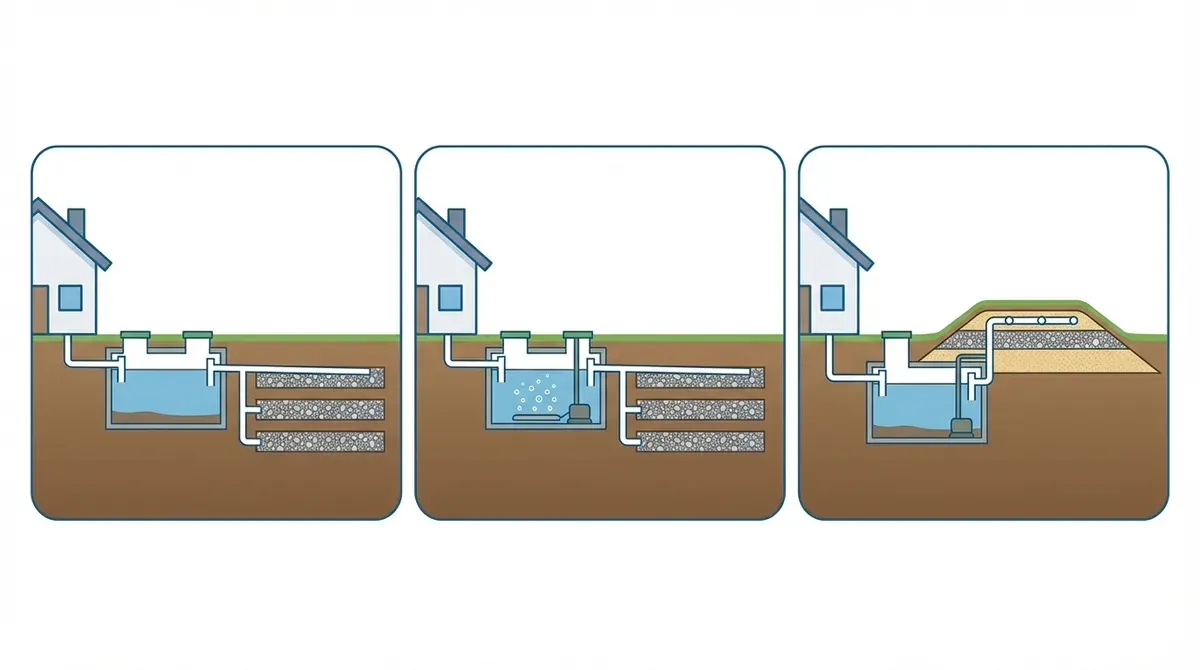
Side-by-side comparison
| Feature | Conventional | Aerobic (ATU) |
|---|---|---|
| Install cost | $3,000–$7,000 | $10,000–$20,000 |
| Annual maintenance | $50–$150 (pumping only) | $500–$800 (service contract) |
| Electricity required | No | Yes |
| Treatment quality | Good | Excellent |
| Drainfield size needed | Larger | Smaller or none |
| Maintenance burden | Low | High (mandatory in most states) |
| Lot size needed | Larger | Smaller |
| Best soil type | Permeable, standard depth | Clay, shallow depth, high water table |
| Drainfield lifespan | 20–40 years | Components: 15–20 years |
| Power outage impact | None | System stops treating during outage |
Aerobic systems: what we found
ATUs produce measurably cleaner effluent, which matters most on small lots, near sensitive water bodies, or where local code requires advanced treatment. They’re also the answer when your lot fails a standard percolation test, since the smaller dispersal area makes them viable where conventional systems are not.
That said, the maintenance reality catches many homeowners off guard. Most states require an annual service contract for ATUs, which runs $500–$800 per year regardless of whether anything breaks. The aerator (the component that injects air) typically lasts 5–10 years before replacement. Spray heads can be a nuisance near outdoor living areas; a slight odor and misting effect are common complaints.
Power outages are a practical problem. When the electricity goes out, the aerator stops and the system reverts to anaerobic treatment. A few hours is manageable; multi-day outages in a storm can compromise water quality at the spray heads.
Conventional systems: what we found
The main advantage is simplicity. No pump to replace, no service contract, no electricity draw. The EPA’s septic care guidelines{:target=“_blank”} put the conventional maintenance obligation at an inspection every 3 years and pumping every 3–5 years for a typical household. That’s $300–$600 per pump-out, nothing more.
Conventional systems do fail, but the failure mode is usually drainfield saturation or overloading, both of which are preventable with proper use. If you’re conservative about what goes down the drain and you schedule regular pumping, a conventional drainfield lasts 20–40 years.
The honest limitation: conventional doesn’t work everywhere. If your soil test shows inadequate percolation or your water table is within 2 feet of grade, you may not have a choice.
Which system should you choose?
Go conventional if your percolation test shows adequate soil absorption, you have enough lot space for standard drainfield setbacks, you want low maintenance with no annual contracts, or you’re cost-sensitive over the long run.
Go aerobic if your lot fails a perc test or has a high water table, local code requires advanced treatment (common near lakes, streams, or in dense rural areas), you have a small lot where a conventional drainfield won’t fit the setback requirements, or you’re near a sensitive water body where effluent quality matters.
We’ve seen homeowners choose aerobic voluntarily on sites that could support conventional, betting on the cleaner effluent quality. That’s a valid choice, but go in with clear eyes about the maintenance cost and the mechanical failure risk over a 20-year period.
FAQ
Is aerobic or conventional septic cheaper to maintain?
Conventional is cheaper by a wide margin. Conventional maintenance runs $300–$600 every 3–5 years for pumping. Aerobic systems require $500–$800 per year for a mandatory service contract, plus the cost of aerator replacement every 5–10 years and pump replacement every 10–15 years. Over a 20-year period, aerobic maintenance costs can run $10,000–$16,000 more than conventional.
Can you switch from aerobic to conventional septic?
Sometimes, but it depends on your soil. If your lot was originally required to use an ATU because it failed a perc test, you can’t simply swap to conventional. The underlying soil condition hasn’t changed. If the ATU was installed voluntarily, a soil engineer can re-evaluate whether a conventional drainfield is feasible. Expect a new permit and roughly $3,000–$7,000 in installation costs.
Do aerobic septic systems smell?
Aerobic systems can produce a mild chlorine-like or earthy smell near the spray heads, particularly after a service visit or during heavy use cycles. This is normal and not a sign of system failure. If the smell is strong or sewage-like, the aerator may have failed and the system is no longer treating waste aerobically. That warrants a service call.
Which type lasts longer?
The septic tanks in both systems have similar lifespans: concrete tanks last 40–50 years, plastic tanks 30–40 years. Our septic tank lifespan guide covers material comparisons in more detail. The difference is in the components around the tank. A conventional drainfield lasts 20–40 years. An aerobic system’s mechanical components (aerator, pump, spray heads) have shorter replacement cycles of 5–15 years per component. Total system lifespan is roughly comparable if maintained, but aerobic requires more active management to reach it.
What happens to an aerobic system during a power outage?
The aerator stops, and the system reverts to anaerobic treatment, essentially functioning like an untreated septic tank. Short outages (a few hours) are generally not a problem. Extended outages may affect effluent quality at the spray heads. Some ATU owners install a generator connection for this reason.
For more on scheduling service and what to expect when the system needs attention, see our septic system pumping guide.