Grease Clogged Drain: How to Remove and Prevent It
Grease clogs build gradually. Fat and oil cool on pipe walls, accumulate over weeks, and eventually slow or stop drainage. Unlike a hair clog that forms in days, grease buildup responds well to heat and natural degreasers when caught early. Wait too long and the fat compacts into a solid obstruction that requires a snake. This guide covers four escalating treatments, from a simple dish soap flush to snaking, plus specific guidance for septic system users.
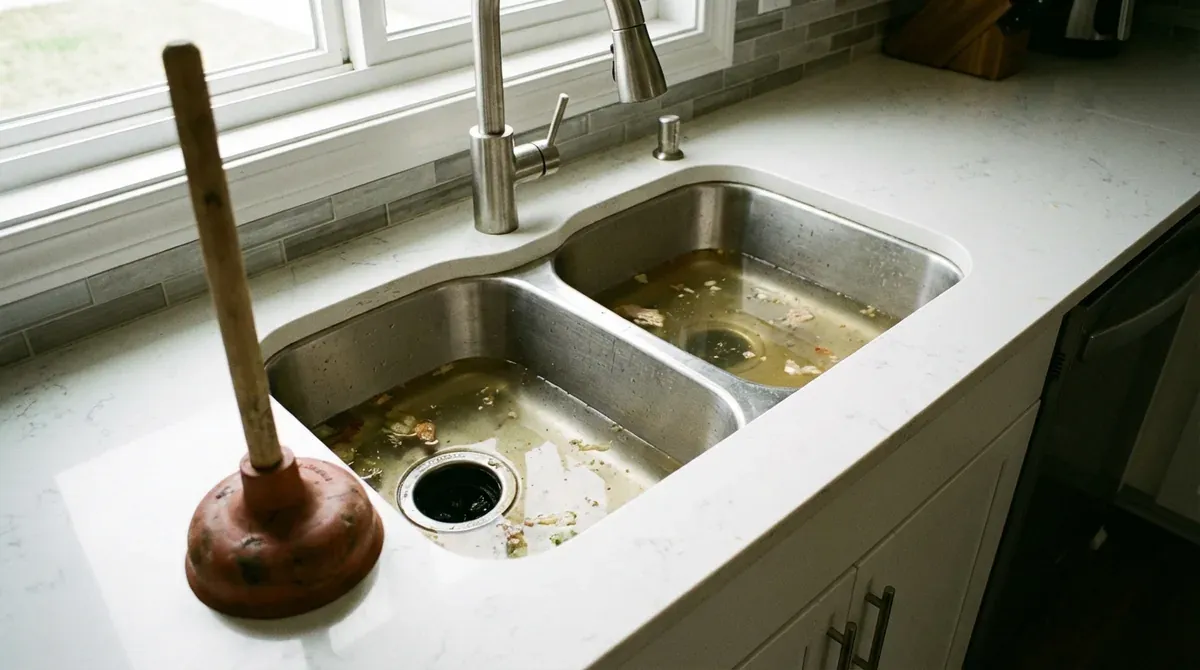
If you’re not sure whether you have a grease clog or a pipe blockage, our kitchen drain clogged causes and fixes guide walks through the diagnosis first.
Why grease builds up in kitchen drains
Grease solidifies inside drain pipes at approximately 68°F, which is standard room temperature. Cooking fats enter the drain as a liquid, travel a few feet into the pipe, and cool enough to leave a thin coating on the walls. Each cooking session adds another layer. Coffee grounds bind to those grease deposits and accelerate buildup significantly. What might take six weeks with grease alone takes three weeks when coffee grounds are part of the mix.
The specific culprits we see most often: bacon fat and lard (solidify fastest), cooking oils like canola and olive oil (solidify slowly but accumulate over months), butter and dairy fat (common in households that rinse dishes without pre-scraping), and salad dressings containing oil and emulsifiers.
ATCO Energy’s plumbing guide puts it plainly: “Practice preventive care by avoiding pouring bacon grease, coffee grounds, or oils down drains.” Dairy rinse water and salad bowl washing belong on that list too. They’re less obvious contributors but build up just as reliably.
How to tell if grease is your problem
Grease clogs have a distinct pattern that separates them from other blockages:
- Drain slows gradually over weeks, not suddenly
- Rancid or sour smell from the drain (decomposing fat smells sour rather than sharp)
- Drain works fine initially but slows after large cooking events like holiday meals
- Hot water helps temporarily but the drain slows again within hours
- Plunger has no effect: pressure doesn’t dissolve grease, it just moves it temporarily
If the drain stopped suddenly with no prior slow-down and there’s no smell, the problem is more likely a physical blockage in the P-trap (food particle, utensil, debris) rather than grease. See our clogged kitchen sink drain pipe guide for that scenario.
Method 1: hot water and dish soap (start here)
This is the first thing to try for a grease clog because it’s fast, free, and effective on recent buildup.
Dish soap (Dawn or any surfactant-based soap) is a degreaser. It emulsifies fat the same way it does when washing greasy dishes: the soap molecules surround fat particles and suspend them in water so they can be flushed away. Combined with hot water, which raises the temperature of the pipe and softens solidified fat, this method clears mild grease buildup in one or two treatments.
How to do it:
- Squirt 2-3 tablespoons of dish soap directly into the drain
- Let it sit for 5 minutes to begin breaking down surface grease
- Pour one full kettle of hot water slowly down the drain, in stages rather than all at once
- Repeat twice
Rodgers Plumbing’s guide recommends pouring “slowly and intermittently to give the hot water some time to work its magic.” The pause between pours lets the heat soften grease before the next volume of water flushes it through.
PVC pipe note: Near-boiling water (just below 212°F) is safe for metal pipes. For PVC pipes (white plastic, common in homes built after 1980), use very hot tap water rather than boiling to avoid softening the joint adhesive over time.
Method 2: baking soda, salt, and hot water
For established grease buildup that dish soap didn’t fully clear, a dry abrasive treatment works differently. The salt physically scours the pipe interior while baking soda neutralizes acidic compounds in rancid grease.
How to do it:
- Make sure the drain is as dry as possible (bail out any standing water)
- Pour 1/2 cup table salt and 1/2 cup baking soda directly into the drain as a dry mixture
- Do not add water yet. Let the dry mixture sit for at least 30 minutes; overnight is better for established buildup
- Pour one kettle of hot water down the drain
- Follow immediately with a dish soap rinse
ATCO Energy’s technique: “Pour about half a cup of table salt down the drain before you pour in the hot water. The coarse salt scours pipe interiors while heat loosens debris.” Their guide notes the baking soda and salt mixture benefits from sitting “for several hours.” The longer contact time gives the salt more opportunity to abrade the grease layer.
This method works well as a monthly maintenance treatment to prevent buildup from forming, not just for clearing an existing clog.
Method 3: baking soda and vinegar flush
This is the most widely recommended natural grease treatment. The chemical reaction between baking soda (sodium bicarbonate, a base) and vinegar (acetic acid) produces carbon dioxide gas. That bubbling action physically pushes grease off pipe walls from inside the pipe, reaching areas that water alone can’t touch.
How to do it:
- Pour 1 cup of baking soda into the drain
- Immediately follow with 1 cup of white vinegar, pouring slowly
- Cover the drain with a stopper or rag immediately. This keeps the CO₂ reaction inside the pipe where it does the work
- Wait 15-30 minutes (ATCO recommends 15 minutes; Rodgers Plumbing recommends 30 minutes for stubborn buildup)
- Flush with a full kettle of hot water
Video: “HOW TO UNCLOG YOUR KITCHEN DRAIN” by Alex The Handyman
LiquidPlumr’s testing of the reaction confirms: “The bubbling action helps break apart clogs into smaller, looser material that can be flushed away.” The boiling water follow-up adds pressure through gravity, helping dislodge the loosened material.
Run two full treatments back-to-back for heavy grease buildup. Most kitchen grease clogs respond by the second treatment.
Septic-safe grease removal options
Methods 1, 2, and 3 above are all safe for septic systems. Here’s what to avoid and what to use instead for long-term maintenance:
Never use: Chemical drain cleaners, including Drano, Liquid-Plumr, or any product containing sodium hydroxide or sodium hypochlorite. These destroy the bacterial culture in your septic tank. Without those bacteria, the tank cannot process waste and will require emergency pumping, which runs $300–$600. The EPA septic system guidance{:target=“_blank”} covers how septic treatment works and what disrupts it.
For maintenance: Enzyme-based drain treatments like Bio-Clean or Roebic K-57 are septic-safe and specifically digest grease over time. They work slowly (24-48 hours) but are good for monthly maintenance on a drain you know has grease buildup. Unlike the immediate action of baking soda and vinegar, enzyme treatments work best as prevention rather than emergency clearing.
Garbage disposal and septic: If you have both a garbage disposal and a septic system, grease management matters more. Food particles from the disposal increase septic tank load, and grease from cooking can coat the tank baffle. We recommend pumping the septic tank every 2-3 years instead of the standard 3-5 years if you use a garbage disposal regularly.
For additional septic-safe drain options, see our home remedies for clogged drains guide.
Method 4: drain snake for compacted grease
When Methods 1-3 don’t clear the clog after two full attempts, the grease has likely hardened into a solid mass that heat and chemical action can’t penetrate. A drain snake physically cuts through it.
How to do it:
- Remove the P-trap under the sink to access the wall drain directly (easier than snaking through the drain opening)
- Feed a 3/8-inch snake cable into the wall drain opening (use 3/8-inch, not 1/4-inch, for grease clogs)
- Rotate the handle clockwise as you push forward
- When you feel resistance, work the snake back and forth without pulling it out yet
- Advance past the resistance point and work the next section
- Pull the snake back slowly, wiping cable with a rag as it comes out
- Reinstall the P-trap and flush with hot water and dish soap
ATCO Energy’s guidance confirms: “Insert the coiled tool into pipes until resistance is felt. Break up clogs without scratching pipe interiors.”
Snake rental runs $30-$50 per day at most hardware stores. The drain snake guide at how to use a drain snake covers cable sizes and technique in more detail.
After snaking, follow with Method 3 (baking soda and vinegar) to dissolve any remaining grease coating the pipe walls.
When to call a plumber
Call a plumber when:
- All four methods failed after two full treatment cycles each
- The grease is in the main drain line, deeper than 25 feet (beyond hand snake range)
- The drain keeps clogging within 2-3 weeks of clearing, which indicates a pipe with significant scale or a low-slope section trapping grease
Professional hydro-jetting costs $300–$600 and is the most effective treatment for severe grease clogs. High-pressure water scours the pipe walls and blasts through even compacted grease. Professional drain snake service alone runs $100–$300 if the clog is accessible. According to EPA wastewater guidance{:target=“_blank”}, grease accumulation in residential drain lines is one of the most common causes of residential sewer service calls.
FAQ
Does vinegar dissolve grease in drains?
Vinegar alone has limited grease-dissolving power. Its acetic acid concentration is too low to break down solid fat. The cleaning action in the baking soda and vinegar method comes primarily from the carbon dioxide produced by the reaction, which physically dislodges grease from pipe walls, and from the hot water follow-up, which softens and flushes the loosened material. Dish soap is more effective at actually dissolving grease because it contains surfactants designed to emulsify fat. For best results, combine dish soap with the vinegar flush in the same treatment session.
Is it safe to pour boiling water down a kitchen drain?
Boiling water is safe for metal pipes (copper, galvanized steel, cast iron) and older ceramic or clay drain pipes. For PVC plastic pipes (white, common in homes built after 1980), repeated use of boiling water can soften joint adhesive over time. We recommend using very hot tap water (the hottest your water heater produces, typically 120-140°F) rather than boiling for PVC systems. The temperature difference is enough to soften grease without stressing the plastic.
How often should I clean my drain to prevent grease buildup?
We recommend a monthly baking soda maintenance flush for any kitchen drain that regularly handles cooking with oils and fats. Pour 1/2 cup each of baking soda and salt, let it sit overnight, flush with hot water. For households with very heavy grease output, do this every two weeks. Clean the drain strainer every 2-3 days. See our full guide on preventing kitchen drain clogs for the complete maintenance schedule.
Can grease clogs cause pipe damage?
Grease itself doesn’t damage pipe material, but a severe grease clog can create enough flow restriction to cause back-pressure in the drain system, which over time stresses pipe joints and can lead to leaks. The more common issue is that grease traps other debris (food particles, coffee grounds, small objects) and the combined mass creates significant obstruction. For septic users, grease that makes it past the drain pipe can coat the septic tank baffle and reduce the tank’s treatment efficiency, eventually requiring earlier pumping.