How Does a Septic Tank Work? A Visual Explanation
A septic tank works by dividing household wastewater into three distinct layers. Solids settle to the bottom, grease floats to the top, and the liquid middle layer drains to a drainfield where soil bacteria finish the job. No moving parts, no electricity required. A conventional system runs on gravity and biology.
Video guide
Video: “How Does a Septic System Work?” by Southwest EFC
The three-layer system
Every drain in your home (toilets, sinks, showers, laundry) flows through a single pipe into the buried septic tank. Once inside, the wastewater separates on its own.
The sludge layer forms at the bottom. Solid waste settles and accumulates there. Anaerobic bacteria in the tank break down some of that organic material over time, but not all of it. Sludge grows, which is why pumping is eventually necessary.
The scum layer floats at the top. Oils, grease, and anything lighter than water collect here. Like sludge, it builds gradually and doesn’t exit the tank on its own.
The effluent layer is the relatively clear liquid that forms in the middle, between scum and sludge. This is the only layer that moves during normal operation. It exits through an outlet baffle and flows into the drainfield.
Standard residential tanks hold between 750 and 1,500 gallons, sized by bedroom count. A 3-bedroom home typically uses a 1,000-gallon tank, sized to give wastewater enough time inside for separation to happen before it moves on.
The EPA’s overview of septic system types describes this settling process as the first stage of a multi-stage treatment system. The tank handles separation. The drainfield handles the biological finishing. Neither works well without the other.
The drainfield: where treatment finishes
Effluent leaving the tank flows into perforated pipes buried in gravel-filled trenches. The gravel distributes it evenly across the field. As it percolates down through the soil, bacteria break down remaining pathogens and nutrients.
Most homeowners underestimate the drainfield’s role. It isn’t just a disposal area; it’s where treatment is completed. Explaining this distinction changes how homeowners think about maintenance: a functioning drainfield is why properly maintained septic systems don’t contaminate groundwater.
The EPA’s care guidelines for septic systems are specific about protecting this component: don’t park or drive on the drainfield (soil compaction kills treatment capacity), plant only native grasses over it (tree roots crack the pipes), and keep roof drains and sump pumps directed away from the field area (saturating the soil shuts down biological treatment).
We’ve seen this failure pattern repeatedly: a camper or boat parked on the drainfield for one season, and two years later the toilets are backing up.
What can go wrong
Most septic failures come down to two problems: sludge overload and drainfield failure.
Sludge overload happens when the tank goes too long without pumping. The sludge and scum layers grow until they crowd out the effluent layer. The EPA sets measurable thresholds here: pump when the sludge bottom is within 6 inches of the outlet pipe, or when the scum top is within 12 inches of the outlet. Past those points, solid material reaches the outlet and enters the drainfield, which is the fastest path to drainfield failure there is.
Drainfield failure is more serious and more expensive. Signs include slow drains across multiple fixtures simultaneously (not just one slow sink), wet or spongy ground over the drain area, and sewage odors near the tank or drainfield. A failed drainfield often requires excavation and full replacement, a job that runs into the thousands of dollars.
Non-flushable items cause their own category of damage. Wipes (including “flushable” ones), dental floss, feminine hygiene products, pharmaceuticals, cooking grease, and household chemicals all harm the system: either clogging the tank mechanically or killing the bacteria responsible for treatment. Garbage disposals increase the solids load well beyond what the tank was sized for; if you have one, you’ll need more frequent pumping than the standard 3–5 year schedule.
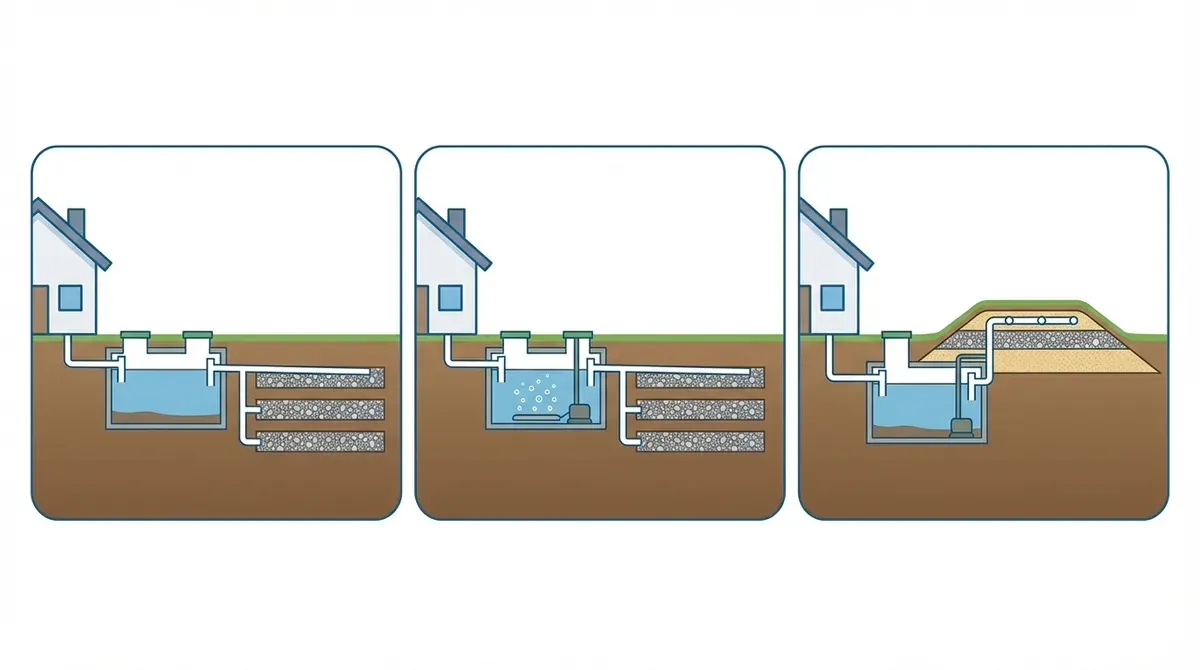
If you’re seeing signs of a problem, check what type of septic system you have before calling a service company. Repair approaches differ significantly depending on whether you have a conventional gravity system or an aerobic vs. conventional septic system.
Maintenance that makes it last
A well-maintained septic system lasts 20–40 years. The maintenance program is simple, but it has to be consistent.
Pump on schedule. We recommend following the EPA’s guidance on professional inspection every 3 years and pumping every 3–5 years for a typical household. Alternative systems with mechanical components require annual inspections. Pumping runs $200–$1,237 depending on tank size and how accessible the lid is; the average homeowner pays around $423. That’s considerably cheaper than a drainfield replacement.
Manage your water load. The average household uses about 70 gallons per person per day. Your tank was sized against that baseline. A family of five in a house built for three puts the system under immediate hydraulic stress. High-efficiency toilets use 1.6 gallons per flush versus the older standard of 3.5–5.0 gallons, a meaningful reduction in daily flow. Spreading laundry across the week rather than running eight loads on Saturday helps, too.
Know what can’t go in. Cooking grease solidifies in the tank and builds the scum layer faster than almost anything. Pharmaceuticals disrupt the bacterial ecosystem. Paper towels and wipes don’t break down the way toilet paper does. None of these belong in a septic-connected drain.
For how frequently to schedule service based on your household size, see our septic pumping guide and our page on when to pump your septic tank.
When you’re thinking beyond maintenance and wondering about how long a septic tank lasts before it needs replacement, the honest answer is that drainfield condition typically determines system lifespan more than the tank itself.
FAQ
How long does a septic tank last before it needs pumping?
A typical household system needs pumping every 3–5 years. The exact interval depends on tank size, household size, and how much solid material enters the system. The EPA recommends inspecting every 3 years and pumping based on sludge depth rather than a fixed calendar schedule. A 1,000-gallon tank serving 3 people might last 5 years; that same tank serving 5 people may need pumping in 2–3 years.
What breaks down in a septic tank?
Anaerobic bacteria in the tank break down organic solid waste: food particles, fecal matter, toilet paper. They reduce volume over time but don’t eliminate sludge entirely. That’s why pumping remains necessary even in well-maintained systems. Inorganic materials (wipes, dental floss, plastics) don’t break down at all and accumulate faster than organic waste.
Can a septic tank overflow?
Yes. When sludge and scum layers crowd out the effluent layer, solids reach the outlet and enter the drainfield. That’s an internal overflow even if nothing surfaces aboveground. Visible backup (sewage returning through floor drains or toilets) happens when the tank is completely full and incoming flow has nowhere to go. Both conditions require immediate pumping.
Does a septic tank need electricity?
A conventional gravity-fed system needs no electricity. Water flows by gravity from the house to the tank and from the tank into the drainfield. Alternative systems are different: aerobic treatment units use air pumps, drip distribution systems use timed dose pumps, and mound systems use pump chambers, all of which require power. A power outage affects those systems in ways it won’t affect a gravity system.
What is the difference between a septic tank and a drainfield?
The septic tank separates wastewater into layers and accumulates solids. The drainfield is where treatment finishes: effluent percolates through gravel and soil where bacteria remove remaining pathogens and nutrients before the water reaches groundwater. The tank and drainfield are both required components; neither functions correctly without the other.