How to Find Your Septic Tank Location
A septic tank is typically buried 10–25 feet from the house foundation, in line with the main sewer pipe exiting the basement or crawl space. Most homeowners locate it within 30 minutes by working through four methods in order: check the property records first, then look for visual clues, then trace the sewer line, then probe the soil with a metal rod.
To understand how a septic tank works before you dig, or to review the types of septic systems on your property, those guides cover the basics.
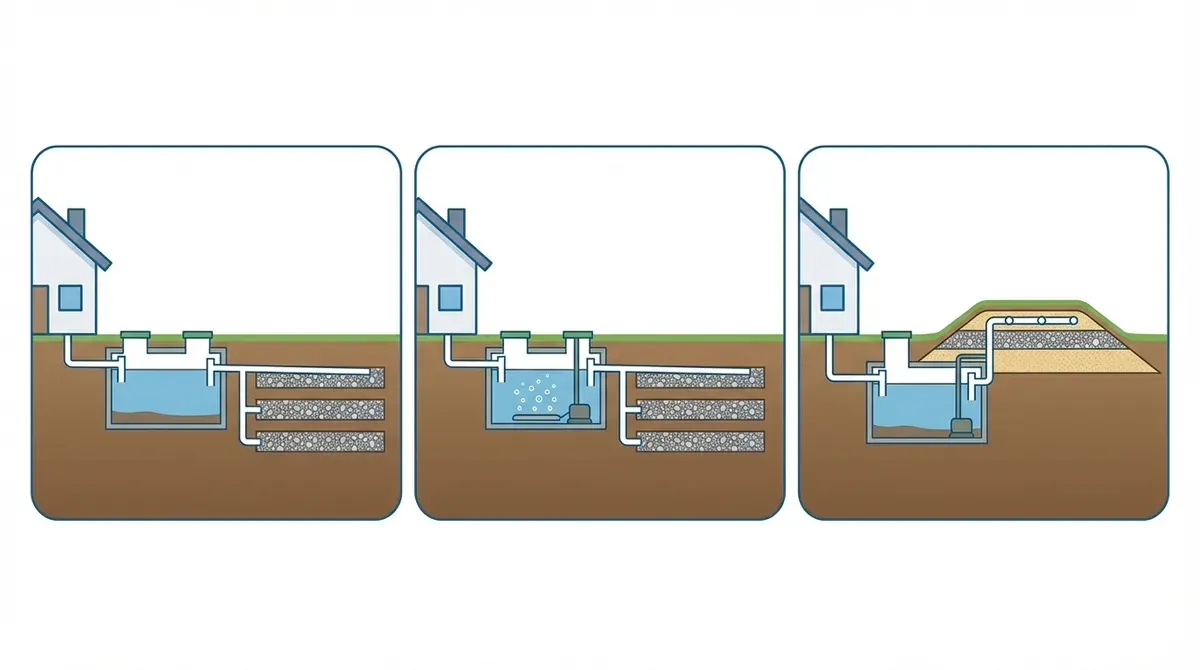
Step 1: check your property records
Start here. No digging, no tools, and it gives you the tank’s exact location if the records exist.
As-built drawing: This is a diagram showing the septic system layout. It should have been included in the documents you received at closing when you bought the home. Check the folder of records from your real estate transaction; look for anything labeled “as-built,” “septic plot plan,” or “site plan.”
County permit records: Septic systems require permits in most jurisdictions, and those records are kept at your county health department, building department, or environmental services office. Many counties now have searchable online databases. Call or visit and ask for the septic permit by address. Records often go back 30–40 years. Per EPA guidelines on septic system types{:target=“_blank”}, conventional systems are buried, watertight structures, and the permit drawing shows exactly where yours is located.
Previous inspection reports: If the home had a septic inspection during the sale process, that report typically includes a sketch of the system location. Ask your real estate agent or the previous owner.
One honest caveat: homes built before the 1970s in rural areas frequently have no permit records. County record systems were inconsistent before modern environmental regulations. If records don’t exist, move to Step 2.
If you’re evaluating a property before purchase, our guide on septic inspection when buying a home covers what to request and what an inspector should find.
Step 2: look for visual clues in the yard
Before you grab any tools, walk the yard with these patterns in mind. This step alone locates the tank on about half of residential properties where records are incomplete.
We’ve found that checking for visual clues in late summer, when surrounding grass is dry and stressed, makes the green patch over the tank dramatically easier to spot than in spring.
Lush green grass during a dry spell: The most reliable visual clue. If there’s a distinct oval or rectangle of greener, thicker grass in an otherwise dry lawn, the tank is likely beneath it. Slight moisture seeping from the tank joints keeps the soil above moister than surrounding ground. This shows up best in summer dry spells, not spring when everything is green.
Low mound or slight depression: A low raised area or a sunken spot can indicate where the tank was buried. Settling soil over an old concrete tank often creates a shallow depression. A mound suggests the tank lid is close to grade.
Inspection ports (risers): Newer systems installed in the 1990s and after often have plastic riser lids above grade: green or black circular caps 12–18 inches in diameter. If you see one, the tank is directly below it.
Cleanout cap in the yard: A single PVC cap protruding slightly from the ground near the house is often a cleanout, not the tank lid, but it confirms the direction the sewer line runs.
Step 3: trace the main sewer line from the house
This method works for almost every property, even without records.
Go to your basement or crawl space and find the main drain pipe, typically a 4-inch black ABS or white PVC pipe exiting through the foundation wall. Note the direction it exits. The septic tank is almost always in that direction, 10–25 feet from the foundation.
Outside, find where the pipe exits the house foundation. From that point, walk in the direction the pipe was heading. The tank sits somewhere along that line. For most homes, you’ll find it within 15–20 feet of the foundation.
If the pipe exits through a finished crawl space and you can’t see it clearly, check the exterior for a small 4-inch stub coming through the foundation, usually just a few inches above grade.
Step 4: probe the soil
Once you’ve identified a likely area from Step 3, probing confirms the exact location without digging.
Tool: A soil probe is simply a metal rod. 3/8-inch rebar cut to 4 feet works fine, or you can buy a commercial probe for $15–$30. Avoid plastic probes; they don’t give you the tactile feedback you need.
Technique: Start 10 feet from the foundation in the direction of the sewer line. Push the probe into the soil and feel for resistance. Concrete tanks produce a solid, dense stop at 1–3 feet depth. Plastic tanks feel hollow with a slight give. Native soil gives uneven, gradual resistance.
Work on a grid pattern, probing every 2 feet in a 6-foot-wide strip along the sewer line direction. Once you hit the tank, mark the edges by probing around the perimeter. A standard septic tank is roughly 5 feet wide and 8–10 feet long.
What doesn’t work: Metal detectors. Concrete and plastic are not ferrous. A metal detector may pick up the tank’s inlet/outlet pipe fittings, but it’s an unreliable way to find the tank itself. Save your time.
When to call a professional locator
Some situations make DIY locating impractical:
- Paved over the tank area: If a driveway or patio was poured over the tank, you’ll need ground-penetrating radar or a professional with locating equipment.
- Large property with no records: On lots of 2+ acres with no landmarks, the search area gets unwieldy.
- Frozen ground: Probing through frozen soil is difficult and can damage probe rods.
- Buried plastic tank: Plastic tanks are harder to feel than concrete; some flex slightly and resist probing.
A professional septic locator charges $75–$150 for the service. Many pumping companies do it free when you book a pump-out at the same time. It’s worth asking.
Once you’ve found the tank, we recommend sketching the location on graph paper and taping it inside a kitchen cabinet. The next time you need it (or the next homeowner does), that sketch is worth $150 in saved locating fees. While you’re at it, check our septic system pumping guide so you know what to expect when the service truck arrives.
Check your septic tank maintenance schedule to know how often you’ll need access to the tank going forward, and whether your system requires annual inspection in addition to periodic pumping.
Per the EPA’s septic care guidelines{:target=“_blank”}, a typical household should have the tank pumped every 3–5 years, which means locating it now saves you from searching again at each service visit.
FAQ
How deep is a septic tank buried?
Most septic tanks are buried with the lid 1–3 feet below grade. The tank itself sits at 4–5 feet depth (bottom of tank). In colder climates, tanks may be buried deeper to prevent freezing, but the lid is rarely more than 3 feet down in residential systems.
Can I find my septic tank with a metal detector?
No. Metal detectors don’t reliably locate septic tanks. Concrete and plastic tanks are not ferrous materials. A metal detector might detect the metal inlet/outlet pipe fittings, but it can’t outline the tank or confirm its location. A soil probe ($15–$30) is far more effective.
What if my property has no records?
Start with the county health department. Records go back further than most homeowners realize, often to the 1960s. If no permit was ever filed (common in rural areas before 1970s regulations), use the sewer line tracing method (Step 3) combined with soil probing. This finds the tank in most cases without records.
Is there an app to find a septic tank?
Some apps claim to locate septic tanks using GPS and property data, but their accuracy depends entirely on whether your county’s records are digitized and publicly shared. A few counties in the Northeast and Midwest have fully digitized their permits; most rural counties haven’t. The app is worth a try as a first step before you start probing; just don’t rely on it exclusively.
How far from the house is the septic tank typically?
Most tanks sit 10–25 feet from the house foundation, measured from where the sewer pipe exits the foundation wall. Local codes typically require a minimum setback of 5–10 feet from the foundation. Tanks further than 25 feet are uncommon in residential systems but do occur on large lots where the installer placed the drainfield in a specific area.
For a full picture of what size septic tank you have and whether it’s adequately sized for your household, that guide covers the sizing standards by household size and tank volume.