How to Increase Well Water Pressure
Low well water pressure (weak showers, slow-filling tubs, a garden hose with the enthusiasm of a leaky faucet) is one of the most common complaints we hear from well owners. The good news: most cases come down to a short list of fixable problems, and at least one of them costs nothing.
Most low well water pressure can be fixed for free by adjusting the pressure switch from 30/50 to 40/60 PSI, a 10-minute job that raises cut-out pressure by 10 PSI.
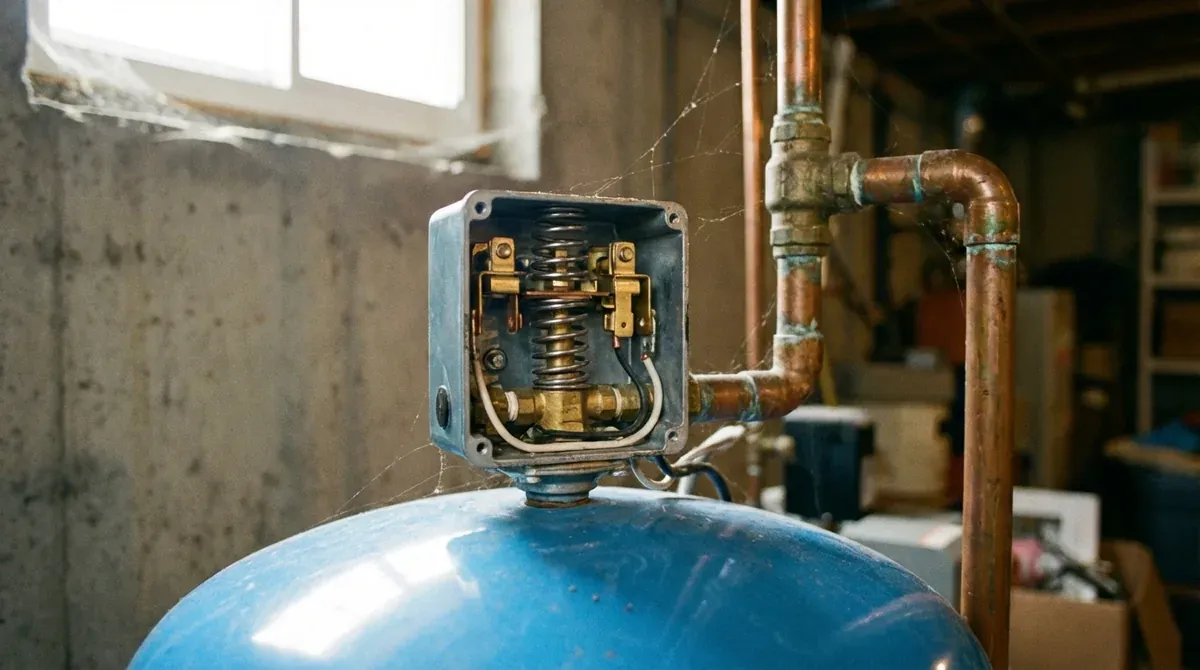
Before spending anything, read through our pressure switch guide to understand how the switch and tank work together. That context makes the fixes below click.
Quick answer
Pressure problems come from three places: the pressure switch setting is too low, the pressure tank is waterlogged, or a clogged filter is restricting flow. Start with the free fixes below. If none of them work, you’re looking at equipment.
Video guide
Video: “How To Increase The Water Pressure With Well Water” by Wells, Septic & More
Free fixes (try these first)
These four steps cost nothing but a few minutes. Do them in order. Most homeowners find the problem before reaching step four.
Fix 1: adjust the pressure switch
The pressure switch mounted on the 1/4-inch tube near your tank controls when the pump turns on and off. Most systems ship set to 30/50 PSI (pump kicks on at 30, shuts off at 50). Switching to 40/60 PSI raises the entire pressure band by 10 PSI.
To adjust your pressure switch, remove the cover, locate the main spring nut (turns the whole range up or down), and tighten it incrementally. One full turn raises pressure roughly 2-4 PSI. Don’t exceed 60/80 PSI. That’s the upper limit for most residential systems and standard pressure tank ratings.
This fix is free and takes 10 minutes. It’s the first thing we check.
Fix 2: check the tank pre-charge
The pressure tank has a small Schrader valve on top, the same type as a bicycle tire. The air pressure inside (the “pre-charge”) should sit at 2 PSI below your cut-in pressure. On a 30/50 system, that’s 28 PSI. On a 40/60 system, 38 PSI.
Steps:
- Turn off the pump at the breaker
- Open a faucet to drain system pressure to zero
- Press the Schrader valve with a small screwdriver to test for air (water = waterlogged tank; see below)
- Use a tire gauge to measure pre-charge
- If low, add air with a bicycle pump until you reach the target
A low pre-charge causes the tank to run out of stored water quickly, making the pump cycle constantly and leaving pressure choppy. This fix costs nothing if you have a bicycle pump.
Fix 3: clean or replace sediment filters
A clogged whole-house sediment filter can drop pressure by 10-20 PSI all on its own. Check the filter housing near where the water enters the house. If the cartridge is dark or hasn’t been changed in 6+ months, swap it out. Filter cartridges run $5–$15 and take 5 minutes to replace.
Sediment from sand or broken check valves is a common culprit, especially in older wells or those drilled in sandy soil.
Fix 4: check for partially closed valves
Gate valves near the pressure tank deteriorate over time. They look open but are partially blocked by scale or a failing gate. Turn each valve fully off and back on (this breaks up any buildup), then reopen completely. While you’re at it, check the valve on the line between the tank and the house.
Equipment upgrades ($100-$1,500+)
If all four free fixes fail, the problem is hardware. Here’s what we’d consider in order of cost.
Option 1: install a constant pressure system ($300–$800)
A variable frequency drive (VFD) controller sits between your pump and the electrical panel. It adjusts pump speed in real-time to maintain steady pressure (typically 50 PSI) regardless of how many fixtures are running. No more pressure drops when someone flushes while you’re showering.
A constant pressure system using a variable frequency drive costs $300–$800 installed and maintains steady pressure regardless of how many fixtures are running simultaneously.
This is the upgrade we’d recommend first if you have the budget. It eliminates the problem instead of working around it.
Option 2: replace an undersized pressure tank ($150–$600)
A small tank runs out of stored water fast, forcing the pump to cycle constantly. Replacing a 20-gallon tank with a 44-gallon model gives you more draw-down, meaning more water available between pump cycles.
To upgrade your pressure tank, you’ll also need to match the new pre-charge to your switch settings. Tank cost runs $150–$350 for the tank alone; budget another $200–$400 for a plumber to install it.
Note: A bigger tank increases draw-down time, not maximum pressure. To raise max pressure, you still need to adjust the switch.
Option 3: add a booster pump ($200–$500)
If your house is far from the well or has multiple stories, a booster pump on the house side of the pressure tank can add 20-30 PSI. This is also the solution when your well yield is fine but pressure drops at upper floors.
Option 4: replace the well pump ($800–$2,000+)
If the pump is more than 10-15 years old or undersized for your household demand, replacing it is the right move. A 1/2 HP submersible pump handles about 10 GPM, fine for 1-2 bathrooms. Larger homes typically need 3/4 HP to 1 HP. This is not a DIY job; hire a licensed well contractor.
What’s causing your low pressure?
Use this table to match your symptom to the likely fix:
| Symptom | Likely Cause | Fix |
|---|---|---|
| Low pressure all the time | Switch too low or undersized pump | Adjust switch or replace pump |
| Pressure drops during heavy use | Tank too small or waterlogged | Replace or upgrade tank |
| Sudden pressure loss | Clogged filter or pipe leak | Replace filter, check pipes |
| Pressure pulses or surges | Waterlogged tank | Test tank pre-charge |
| Gradual decline over months | Pump wear or dropping well level | Professional inspection |
If your pump is running constantly without pressure building, that often points to a well pump not working situation: a broken pipe, failed check valve, or submersible pump issue that’s outside the scope of pressure adjustment. If the pump is running but not moving water at all, see our guide on pump runs but no water for a separate diagnostic path.
What is normal well water pressure?
Normal well water pressure ranges from 40 to 60 PSI at the fixtures. Below 30 PSI is noticeably weak; above 80 PSI can damage plumbing and appliances.
The EPA private well guidelines{:target=“_blank”} recommend keeping residential water pressure between 30 and 80 PSI. Most plumbing codes echo this range.
To test yours: attach a pressure gauge to an outdoor hose bib, or install a pressure gauge on the tank fitting for a permanent reading. You’re looking for 40-60 PSI when the pump is off and the system is at rest. Below 40 PSI at rest means the switch setting is too low. Fluctuating wildly usually means the tank.
Pressure-reducing valves (PRV) solve the too-high side. If your system sits above 80 PSI (common after a well service that over-pressurized the tank), install a PRV at the house entry. They cost $30–$80 and take about an hour to install.
FAQ
What PSI should well water be?
A residential well system should deliver 40–60 PSI at the fixtures during normal use. Most pressure switches are set to 30/50 PSI (acceptable) or 40/60 PSI (preferred for better flow). Below 30 PSI causes noticeable weakness at faucets; above 80 PSI can damage appliances and pipe fittings over time.
Can I increase well pump pressure to 80 PSI?
We don’t recommend it. Most residential bladder tanks are rated to 100 PSI burst pressure, but the safe working pressure is typically 60 PSI maximum. Pushing to 80 PSI also requires setting the cut-out at 80, which puts constant stress on the pump and tank bladder. A better approach is a constant pressure system, which maintains 50-60 PSI efficiently.
Why is my well water pressure low in the morning?
Morning low pressure usually means the tank pre-charge has dropped. When the house is unused overnight, the tank should hold pressure. If it drops to near cut-in by morning, air has bled out of the bladder. Check the Schrader valve with a tire gauge after draining the system. The pressure switch manufacturer specs{:target=“_blank”} provide guidance on cut-in settings for your specific switch model.
Will a bigger pressure tank increase water pressure?
Not directly. A larger tank increases draw-down capacity, meaning more water available before the pump turns on. It won’t raise your maximum pressure. To raise pressure, adjust the pressure switch settings. A larger tank paired with a pressure switch adjustment gives you both better pressure and more between-cycle capacity.