Septic Tank Sizes: How to Choose the Right One
The quick answer: 1,000 gallons for a 1-3 bedroom home, 1,250 gallons for 4 bedrooms, 1,500 gallons or more for larger households. Most states set 1,000 gallons as the minimum regardless of bedroom count. Sizing is based on the EPA baseline of 70 gallons per person per day, not the actual number of people living in the house, but the number of bedrooms as a proxy for occupancy.
This page explains how the math works, what happens when a tank is undersized, and when to consider upsizing.
Standard septic tank sizes by household
| Bedrooms | Tank Size | Estimated Daily Flow |
|---|---|---|
| 1–2 | 750–1,000 gal | 150–250 gal/day |
| 3 | 1,000 gal | 300–350 gal/day |
| 4 | 1,250 gal | 400–450 gal/day |
| 5–6 | 1,500 gal | 500–600 gal/day |
| 7+ | 2,000 gal+ | 700+ gal/day |
The 750-gallon tank is mostly found in older homes. Current codes in most states start at 1,000 gallons even for a single-bedroom property. If you’re buying a property with a 750-gallon tank, confirm whether it meets current local code before assuming the system is adequate.
The EPA’s guidance on septic system types establishes the underlying principle: tank sizing must accommodate enough liquid volume to allow solids to settle before effluent reaches the drainfield. Undersized tanks rush wastewater through before that separation is complete.
How septic tank size is calculated
The sizing formula uses daily wastewater flow, not a fixed rule.
The EPA estimates average household water use at about 70 gallons per person per day. Local codes typically translate that to bedrooms rather than actual occupancy, using bedroom count as a conservative proxy for potential peak occupancy. A 3-bedroom home might have 2 residents today and 5 next year, so the code accounts for the higher scenario.
Here’s the basic math for a 3-bedroom home:
- 3 bedrooms × 2 occupants per bedroom = assumed 6 occupants
- 6 occupants × 70 gallons/day = 420 gallons/day
- Tank should hold 2–3 days of flow minimum for adequate settling time
- 420 × 2.5 days = 1,050 gallons, so round up to 1,000–1,250 gallon tank
Your local health department or permitting office will have the specific sizing requirement for your county. Some states require larger tanks; some adjust the formula based on soil type or lot conditions. The bedroom-count method is a starting point, not a universal rule. We recommend calling your county health department before purchasing any tank, since local minimums sometimes exceed the bedroom-count formula by 250–500 gallons.
Does system type affect tank size?
Yes, in some cases. A conventional gravity system uses a single septic tank sized by the formula above. Alternative systems add components with their own volume requirements.
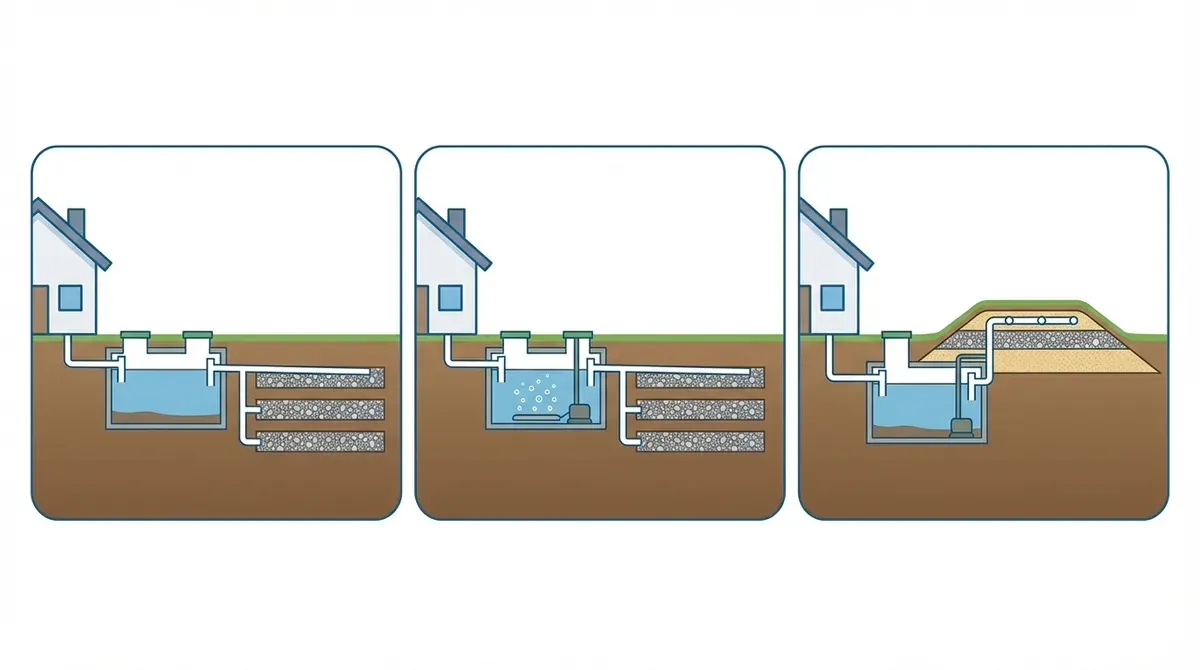
Aerobic treatment units (ATUs) have a separate aeration chamber in addition to the settling tank. The total capacity is similar, but the volume is split across two or more compartments. Drip distribution systems add a dose tank after the septic tank, sized to hold a timed dose of effluent for pump delivery into the drainfield. Mound systems use a pump chamber separate from the main tank.
If you’re comparing system options for new construction, see our guide to septic system types to understand how each system’s component list affects your total installation footprint and cost.
The sizing requirements above apply to conventional gravity systems. Ask your installer or permitting office for component-specific sizing if you’re going with an alternative system.
What happens if your tank is too small
An undersized tank fails in a predictable way. When wastewater flows in faster than the tank can process it, residence time drops. Solids don’t settle completely before effluent exits to the drainfield. Solid particles then reach the drainfield and clog the soil, which is the beginning of drainfield failure. We’ve found this is the most common cause of premature septic tank repair cost spikes, where the tank was undersized for the household from the start.
The warning signs are usually slow drains across multiple fixtures (not just one clogged drain), sewage odors near the tank or drainfield area, and unusually wet or spongy ground over the drain lines.
The EPA’s septic care guidelines define the pumping thresholds in physical terms: pump when the sludge layer is within 6 inches of the tank outlet, or when the scum layer is within 12 inches of the outlet. An undersized tank reaches those thresholds faster, which means more frequent pumping bills and higher long-term operating cost.
For context on what repair and pumping runs, see our septic system pumping guide.
Material and size relationship
Tank material affects what sizes are available.
Concrete tanks come in the full range: 750 gallons up through 2,000+ gallons. They’re heavy (a 1,000-gallon concrete tank weighs roughly 8,000 pounds), which means installation requires equipment, but they’re durable and widely available in large sizes.
Plastic and fiberglass tanks top out around 1,500 gallons in most markets. They’re lighter and easier to install in tight access situations, but large-capacity options are limited. For a household requiring a 2,000-gallon tank, concrete is usually the only practical option.
For a head-to-head comparison of material trade-offs, see our guide to plastic vs concrete septic tanks. The size question often settles the material question for you.
When to upsize
Four situations commonly justify upgrading to a larger tank:
Adding bedrooms. Any permitted bedroom addition changes the code-required tank size. Some jurisdictions require a tank upgrade when a bedroom is added; others don’t enforce it retroactively. Check with your local health department, since the permit process for an addition typically triggers a septic review.
Increased occupancy. Moving from 2 residents to 6 puts dramatically more daily flow into a tank sized for the lower occupancy. The system won’t fail overnight, but pumping frequency increases and drainfield stress builds.
Installing a garbage disposal. A disposal increases the solids load going into the tank. The EPA notes that systems with disposals need more frequent pumping. Some states require a larger tank if you’re adding one.
Switching from municipal to private septic. If a property previously connected to city sewer is being disconnected and switching to a private system, the tank must be sized from scratch against current code, not based on whatever the lot may have had decades ago.
Upsizing means replacing the tank, not just pumping it. See our new septic system cost guide for a realistic picture of what that involves. Properly sizing a new tank also affects how long your septic tank lasts. An undersized replacement will fail on the same accelerated timeline as the original.
FAQ
What size septic tank do I need for a 3-bedroom house?
A 3-bedroom home typically requires a 1,000-gallon tank under most state codes. That handles an estimated 300–350 gallons of daily wastewater flow with enough residence time for proper settling. If local code sets a higher minimum or your household has more than 6 regular occupants, a 1,250-gallon tank is the next step up.
What is the minimum septic tank size?
Most states set 1,000 gallons as the minimum, even for a 1-bedroom property. Some states allow 750-gallon tanks for very small homes, but these are the exception. Check your local health department for the applicable minimum; it’s set by state or county code, not by a national standard.
How many people can a 1,000-gallon septic tank handle?
A 1,000-gallon tank is designed for a household using roughly 250–350 gallons per day, which corresponds to 4–5 people at 70 gallons per person per day. At full design capacity with a typical pumping schedule of every 3–5 years, the system can handle that load. More people means more frequent pumping. The tank isn’t damaged, but the sludge accumulation rate increases.
How does water usage affect tank sizing?
Higher daily water use increases the flow rate through the tank, reducing residence time for solids to settle. The EPA uses 70 gallons per person per day as the design baseline, but households with teenagers, frequent guests, or high-flow fixtures will exceed that. High-efficiency toilets (1.6 gallons per flush vs. the older 3.5–5.0 gallon standard) and low-flow showerheads meaningfully reduce daily load and extend the interval between pumpings.
How often does a properly sized tank need pumping?
Every 3–5 years for a typical household, per EPA guidance. A tank sized correctly for the household and maintained on schedule should comfortably hit the 5-year mark before sludge depth reaches the 6-inch-from-outlet threshold. Smaller tanks, larger households, or systems with garbage disposals shorten that interval. Annual inspection of sludge depth is the most accurate way to calibrate your specific schedule.